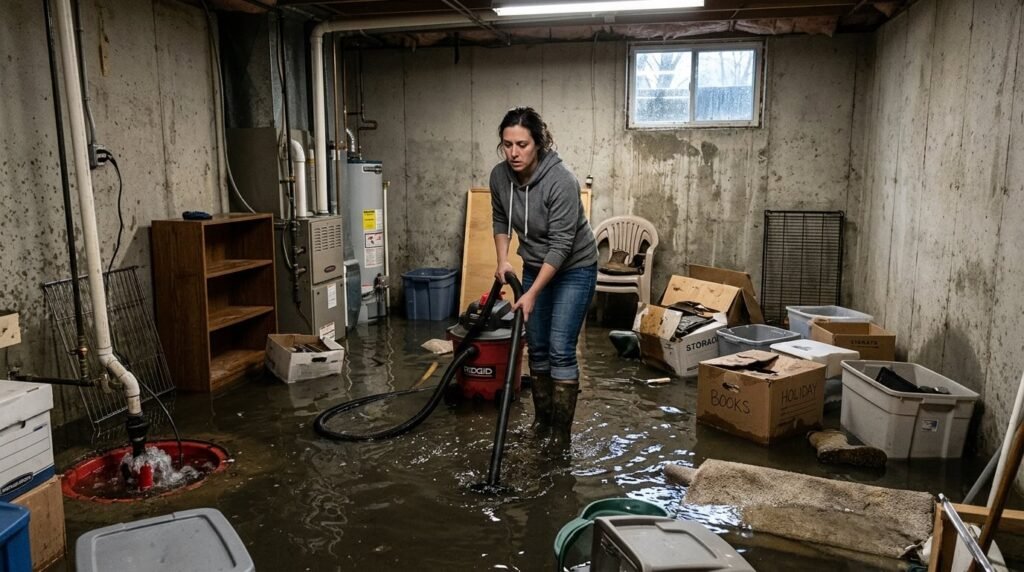

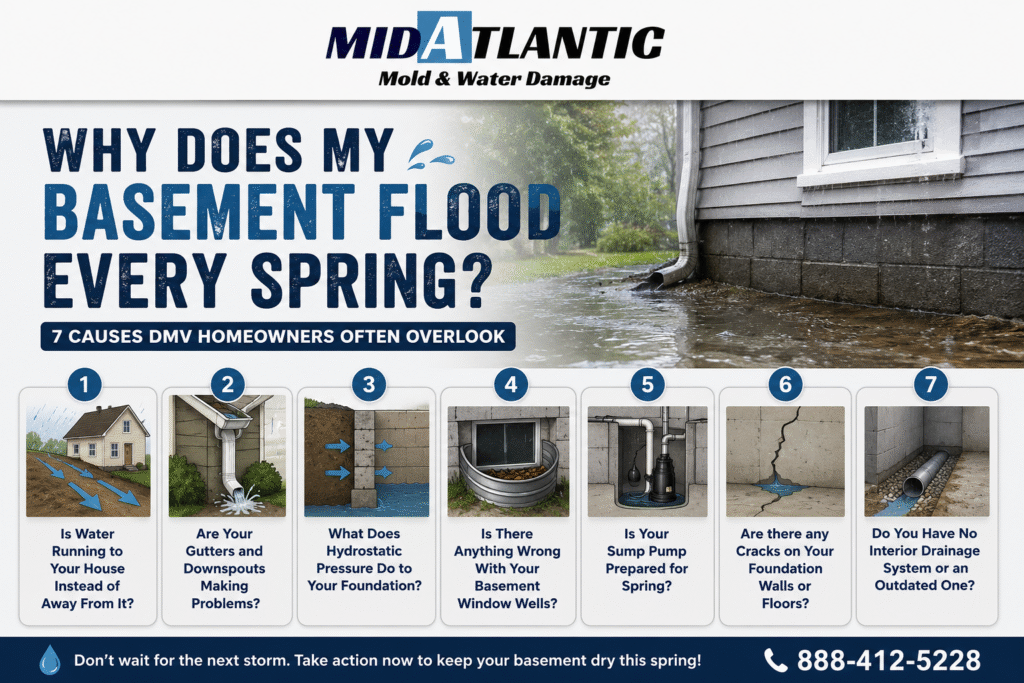
In this blog, we explain to homeowners from the DMV area the reason why their basements flood each year in spring and the underlying causes behind this problem. Learn about seven hidden causes, ways of preventing them, and when you should contact a professional. If you have been fighting this issue for decades or just started noticing the problems, here are your solutions.
Key Takeaways
- Poor grades near your property are among the most common and yet ignored factors that contribute to flooding in the spring.
- Clogged or broken gutters allow thousands of gallons of water straight at your foundation every year.
- The invisible hydrostatic pressure can crack your foundation walls without a moment’s notice.
- A sump pump that malfunctions in the middle of a spring rainstorm is a surefire way to experience water damage fast.
- The earlier you take care of the problem, the less you will have to spend on foundation waterproofing services.
In fact, flooding in your basement during spring usually results from certain issues that you can solve. Basement water damage restoration involves far more than just cleaning; it includes determining what makes water get into your basement and preventing its entry so that you don’t suffer any damage to your structure, possessions, or health. If you want to prevent all these, basement water damage restoration starts with finding out the cause of water damage.
MidAtlantic Mold and Water Damage is ready to assist you in identifying the source of recurring water damages, especially in case you live in the DMV region. Thanks to highly efficient basement waterproofing services in DMV, we will help you get rid of your worries related to rainwater. Check out our website now!
1. Is Water Running to Your House Instead of Away From It?
Most people don’t think about the grade of their yard until there’s water in the basement. Your property needs to slope away from your foundation at the rate of six inches for every ten feet. Otherwise, when it rains or melts, the water runs toward your house instead of away from it.
Soil settles over time, and the grade of your yard will change accordingly. An experienced basement waterproofing contractor will be able to check your property grade and make recommendations before the spring rains come around.
2. Are Your Gutters and Downspouts Making Problems?
- If you have clogged gutters, they can spill water near the edge of your foundation.
- With downspouts located within six feet from the side of the house, you will accumulate water around the house.
- When downspouts break or become disconnected, instead of directing water away from your property, they deposit it underground.
- Sagging gutters that have detached themselves from your roofline cause water to drip directly on your home’s siding and then flow down.
Cleaning your gutters once per year and installing downspouts are some of the easiest things that you can do as part of the water damage restoration services.
3. What Does Hydrostatic Pressure Do to Your Foundation?
As your property’s soil becomes saturated due to rains in the spring season and melting snow, hydrostatic pressure can be created by the buildup of water around and under your foundation. Hydrostatic pressure is such that it can make water flow through concrete surfaces even through hairline cracks.
This type of problem needs a special treatment that can be found through foundation waterproofing services. Installing interior and exterior drain systems, along with a sump pump system, may reduce the effects of this pressure. Bowing walls and efflorescence are some signs that hydrostatic pressure has started working against your foundation.
4. Is There Anything Wrong With Your Basement Window Wells?
Window wells are prone to accumulating leaves, dirt, and water. However, without proper drainage and covers, window wells are also an easy passageway for water to get inside through your basement windows. Many DMV residents are unaware that their window wells do not have enough gravel drainage or that the window wells themselves are rusty and no longer attached to the basement walls.
Have your basement window wells covered up and ensure that there is at least 6 inches of gravel in each well. In case water is coming inside, contact a basement flood cleanup company to address the problem.
5. Is Your Sump Pump Prepared for Spring?
Your sump pump serves as your final safeguard against basement flooding. However, if you haven’t checked on your sump pump recently, you run the risk of its failure at precisely the wrong time, during a spring rainstorm.
- Test that the float switch works without obstruction.
- Test that the automatic start mechanism works by pouring water into the pit.
- Make sure the discharge hose extends far enough from your house.
- Install a battery-powered backup unit in case there’s no electricity.
One of the most common ways in which DMV homeowners find themselves requiring water damage restoration service specialists is because their sump pumps have failed in spring rainstorms.
6. Are there any Cracks on Your Foundation Walls or Floors?
As years go by due to freeze-thaw conditions, cracks start forming within your foundations. The thing about water is that it enters through each and every crack.
- Horizontal cracks may be indicative of stress and should be attended to as soon as possible.
- Vertical cracks are generally formed when there is settlement of the structure and can lead to large volumes of water entering into the structure.
- Floor cracks are where the water from the ground can enter the home.
7. Do You Have No Interior Drainage System or an Outdated One?
Often, old DMV properties do not have any interior drainage system. In some other situations, the system may be outdated and incapable of handling the present-day rainfall amounts.
Interior French drains, offered by basement waterproofing services, direct water entering the basement toward a sump pit before it spreads out across the whole basement floor. If you lack an interior drainage system, your basement could become infected with mold and wood rot.
End the Cycle of Spring Flooding
You do not have to experience yearly spring floods; each and every cause above can be solved with professional intervention and proper timing. The DMV area’s climate makes homes highly susceptible to basement flooding, but local professionals know how to solve these problems.
MidAtlantic Mold and Water Damage provides waterproofing for foundations as well as basement flood cleanup company services for quick relief of current water issues and waterproofing solutions made specifically for DMV residents. Rather than simply dealing with the surface-level problem, our team addresses and solves the underlying cause of your flooding issues.
FAQs:
- When should I consult a professional for water damage restoration in my basement?
Contact a professional if you notice standing water, mold growth, musty smells, or water damage on your walls or floors.
- How expensive are basement waterproofing costs?
Depends on the technique used, but interior drains usually cost between $3,000 to $10,000.
- Can I waterproof the basement on my own?
It depends on whether you want to seal some minor cracks, but waterproofing the entire area is best left to a basement waterproofing expert.
- What’s the right timing to contact a flood cleanup firm after a flood disaster?
Call within 24-48 hours after water damage because mold can start forming within 24 hours.
- Does MidAtlantic Mold and Water Damage handle all DMV locations?
MidAtlantic Mold and Water Damage provides its waterproofing and flood cleanup services across Washington, D.C., Maryland, and Virginia.