
A trucking company’s handbook says, in one line, that drivers can’t use their phones while driving. Straightforward enough, until a driver hits unexpected construction, needs to reroute through unfamiliar navigation, gets a call from dispatch about a delayed pickup, or has a mechanical warning light come on fifty miles from the nearest exit. The written rule doesn’t say what to do in any of those moments. A distracted driving policy that stops at “don’t use your phone” hasn’t actually told a driver what safe behavior looks like once the road gets complicated, and the complicated moments are exactly when a policy needs to be clear.

What Federal Rules Actually Require
For commercial drivers operating a commercial motor vehicle in interstate commerce, federal rules are more specific than most company handbooks. Under 49 CFR 392.82, a driver can’t hold a mobile phone to talk, dial or answer by pressing more than a single button, or reach for a phone in a way that takes them out of a seated, belted driving position. A separate rule, 392.80, bans texting outright while driving. Hands-free use is allowed, but narrowly: the phone has to be positioned so a call can be started, answered, or ended with a single touch, without the driver reaching beyond the dashboard or losing their seated position.
It’s worth being precise about who these rules cover. They apply specifically to drivers operating commercial motor vehicles as defined by FMCSA, generally trucks and buses meeting certain weight or passenger thresholds operating in interstate commerce. A sales employee driving a company sedan, or a technician driving a personal vehicle for work, isn’t covered by these specific federal rules at all. For those employees, state law and company policy are what set the rules, which is exactly where a written company policy has to do more work than simply restating a federal regulation that may not even apply to everyone on the payroll.
The Emergency Exception Doesn’t Mean What Many Drivers Assume
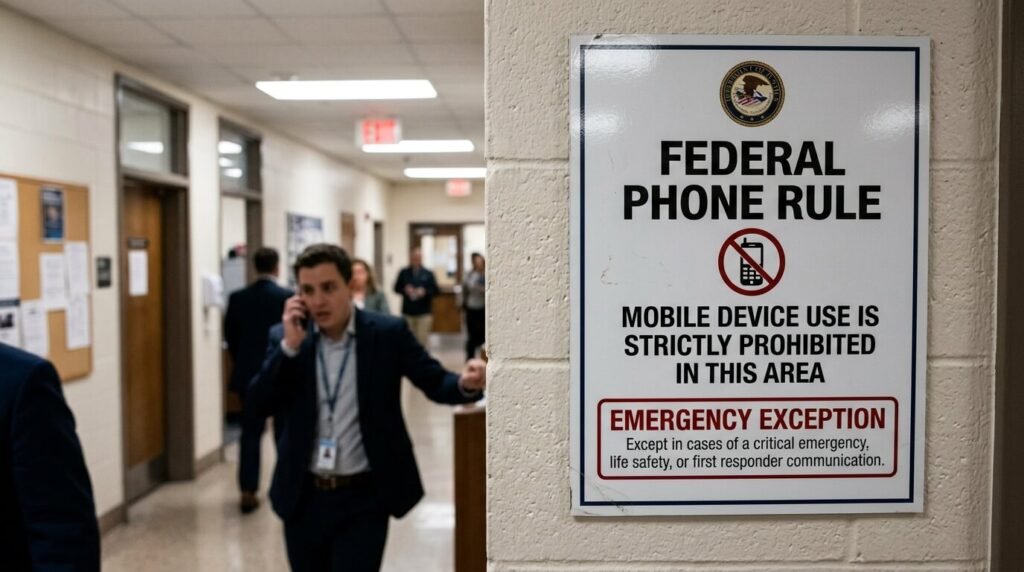
Both 392.80 and 392.82 include an emergency exception, and it’s narrower than it sounds. The rule permits handheld phone use or texting “when necessary to communicate with law enforcement officials or other emergency services.” That’s it. Industry guidance interpreting the rule has been direct about what doesn’t qualify: running late, a scheduling conflict, or another operational inconvenience the driver wants to flag to dispatch does not count as an emergency under the federal exception, even if it feels urgent to the person behind the wheel.
This is precisely the kind of gray area that trips up well-intentioned drivers. Someone who’s run into unexpected traffic and wants to give dispatch a heads-up about a delayed delivery may genuinely believe that’s a permitted use of the phone, since it feels operationally important. Federally, it isn’t covered by the emergency exception at all. A driver trying to follow the rules in good faith can still end up violating them, simply because nobody explained where the actual line sits. It’s also worth noting what the rule does allow structurally: a driver who pulls fully off the highway and stops in a location where the vehicle can safely remain stationary is no longer considered to be “driving” under the regulation’s own definition, which means phone use at that point isn’t restricted by these particular sections at all.
Where Company Policy Has to Go Further Than Federal Law
Federal rules set a floor, not a complete playbook. A company’s distracted driving policy needs to answer questions federal law doesn’t address at all: how should a driver communicate with dispatch about a genuine operational problem without pulling over every time? What’s the company’s own stance on hands-free calls, given that research on cognitive distraction has found hands-free conversations still divert attention even when they’re legally permitted? How should navigation be handled, given that entering a destination is itself a visually and mentally demanding task regardless of whether the phone is handheld or mounted?
None of these are federal questions. They’re company policy questions, and a policy that only repeats “follow FMCSA rules” without addressing them has left the actual day-to-day decisions up to individual judgment in the exact moments judgment is hardest to exercise safely.
A Practical Checklist for Closing the Gray Areas
A distracted driving policy that can actually guide behavior on the road tends to address these areas explicitly, rather than assuming they’re obvious:
- Who the policy applies to commercial drivers under FMCSA rules, other employees driving company or personal vehicles for work, or both.
- What counts as prohibited phone use, spelled out rather than left to the word “distraction.”
- Whether hands-free calling is permitted, restricted, or banned outright by company choice.
- How navigation should be handled set before driving, pulled over to adjust, or voice-only.
- When and where a driver should pull over to communicate, including what counts as a safe stopping point.
- What genuinely counts as an emergency under the policy, distinguished clearly from an operational issue.
- How drivers should reach dispatch about delays or problems without violating phone-use rules.
- What training drivers receive on the policy, not just a signature on a form.
- How violations are enforced and whether coaching precedes formal discipline.
- How often the policy gets reviewed and updated as technology and routes change.
A policy missing several of these isn’t necessarily non-compliant with federal law, but it’s likely leaving drivers to improvise in exactly the situations where a clear answer would help most.
How Technology Supports a Written Policy
Even a well-written policy depends on some way of knowing whether it’s actually being followed, which is where many companies rely on trust alone. Tools built around driving safety can give a company visibility into whether phone use is actually happening during trips, turning a policy from a document into something that can be checked and discussed rather than assumed. That visibility doesn’t replace the policy itself, and it doesn’t resolve the gray areas on its own. It just gives a company a way to know whether the answers it wrote down are the answers drivers are actually following.
A distracted driving policy earns its usefulness in the specific moments a generic rule doesn’t cover: the unexpected detour, the call from dispatch, the mechanical warning light on an empty stretch of highway. Spelling out those situations in advance, rather than leaving drivers to guess where the federal emergency exception ends and company judgment begins, is what separates a policy that sits in a handbook from one that actually shapes behavior on the road. Platforms like My Drive Guardian are part of how companies verify that gap is actually closing, rather than assuming a written policy is enough on its own.
FAQs
Does the FMCSA emergency exception allow a commercial driver to call dispatch during a delay?
No. The federal emergency exception under 49 CFR 392.80 and 392.82 covers communication with law enforcement officials or other emergency services only. Operational issues like delays or scheduling problems, even if urgent to the driver, are not covered.
Do FMCSA phone restrictions apply to all company drivers?
No. These specific federal rules apply to drivers operating commercial motor vehicles in interstate commerce. Employees driving company cars or personal vehicles for work who don’t meet that definition aren’t covered by these particular regulations; their phone use is governed by state law and company policy instead.
Can a commercial driver use a phone after pulling over?
Generally, yes. Under the federal rule’s own definition, a vehicle that has been moved to the side of or off the highway and stopped in a location where it can safely remain stationary is no longer considered to be “driving,” which means these specific restrictions no longer apply at that point.