
Rabbit IgG Antibodies are among the most trusted tools in biomedical research, diagnostics, and biotechnology. Scientists rely on them because they offer high specificity, strong affinity, and excellent sensitivity when detecting proteins, pathogens, and biomarkers. Whether used in Western blotting, ELISA, immunohistochemistry, or immunofluorescence, Rabbit IgG Antibodies consistently deliver reliable results.
This guide explains what Rabbit IgG Antibodies are, how they are produced, their advantages, applications, purification methods, and best practices for laboratory use.
What Are Rabbit IgG Antibodies?
Rabbit IgG Antibodies are immunoglobulin G molecules produced by rabbits after exposure to a specific antigen. These antibodies recognize and bind to target molecules with remarkable precision.
IgG is the most abundant antibody class found in rabbit serum and plays a vital role in the adaptive immune response. Researchers commonly generate rabbit antibodies by immunizing rabbits with purified proteins, peptides, or other antigens. After the immune response develops, serum containing Rabbit IgG Antibodies is collected and purified for research or diagnostic purposes.
Why Researchers Prefer Rabbit IgG Antibodies
Rabbit-derived antibodies have several advantages over antibodies produced in many other laboratory animals.
Higher Affinity
Rabbits often produce antibodies with stronger binding affinity, allowing scientists to detect proteins that exist in very low concentrations.
Better Specificity
Rabbit IgG Antibodies recognize unique epitopes that may not trigger a strong immune response in mice, making them ideal for difficult targets.
Strong Immune Response
Rabbits generate robust immune responses against small peptides and highly conserved proteins, producing high-quality polyclonal antibodies.
Broad Research Applications
Because of their sensitivity and reliability, Rabbit IgG Antibodies are widely used in academic laboratories, pharmaceutical companies, hospitals, and biotechnology industries.
Structure of Rabbit IgG Antibodies
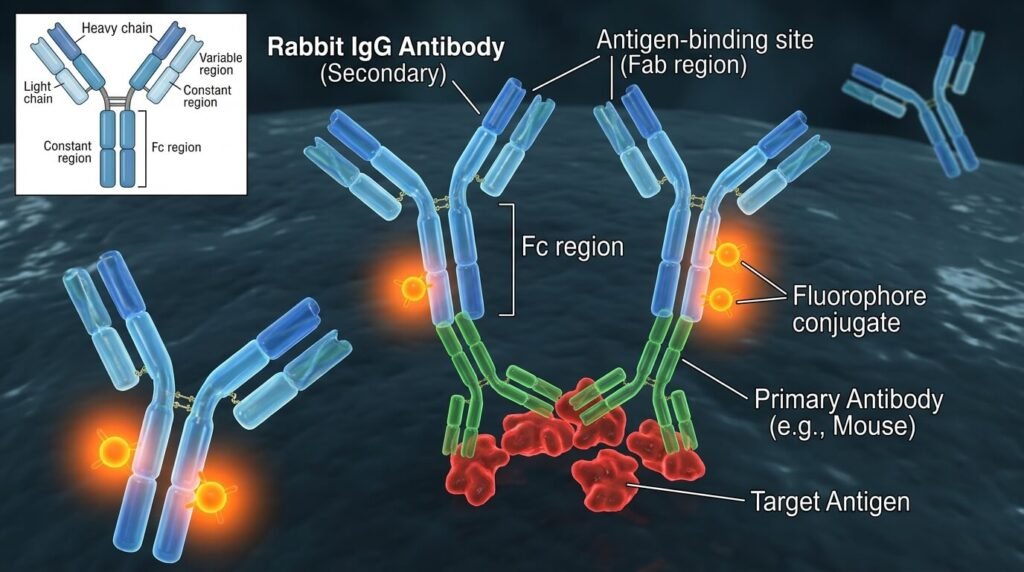
Like other IgG molecules, Rabbit IgG Antibodies contain:
- Two heavy chains
- Two light chains
- Two antigen-binding Fab regions
- One Fc region
The Fab region binds the antigen, while the Fc region interacts with immune cells and purification proteins such as Protein A.
This structure enables efficient antigen recognition while supporting purification and detection methods commonly used in laboratories.
How Rabbit IgG Antibodies Are Produced
Production involves several carefully controlled steps.
1. Antigen Selection
Researchers select the protein, peptide, or molecule that needs to be detected.
2. Rabbit Immunization
The antigen is injected into rabbits over several weeks with booster doses to strengthen the immune response.
3. Serum Collection
Blood samples are collected once antibody levels reach the desired concentration.
4. Purification
Scientists isolate Rabbit IgG Antibodies from the serum using chromatography techniques.
5. Quality Testing
Purified antibodies undergo testing for specificity, affinity, purity, and performance before distribution.
Common Applications of Rabbit IgG Antibodies
The versatility of Rabbit IgG Antibodies makes them valuable across numerous scientific fields.
Western Blotting
Researchers use them to identify specific proteins within complex biological samples.
ELISA
They detect antibodies, hormones, proteins, viruses, and biomarkers with high sensitivity.
Immunohistochemistry (IHC)
Rabbit IgG Antibodies help visualize proteins inside tissue sections, supporting disease diagnosis and pathology research.
Immunofluorescence
Fluorescently labeled antibodies reveal protein localization within cells under a fluorescence microscope.
Flow Cytometry
These antibodies identify cell populations and analyze protein expression in thousands of cells within minutes.
Immunoprecipitation
Scientists isolate target proteins from cell lysates to study protein interactions and signaling pathways.
Diagnostic Testing
Clinical laboratories use rabbit antibodies in diagnostic assays for infectious diseases, cancer biomarkers, and autoimmune disorders.
Polyclonal vs. Monoclonal Rabbit IgG Antibodies
Polyclonal Rabbit IgG Antibodies
These consist of multiple antibody populations that recognize different epitopes on the same antigen.
Advantages
- High sensitivity
- Strong signal
- Cost-effective
- Excellent for detecting low-abundance proteins
Monoclonal Rabbit IgG Antibodies
These originate from a single B-cell clone and recognize one specific epitope.
Advantages
- High specificity
- Excellent reproducibility
- Lower background staining
- Consistent batch-to-batch performance
Researchers select the antibody type based on experimental requirements.
Purification Methods
Purification significantly influences antibody quality and laboratory performance.
Common methods include:
- Protein A affinity chromatography
- Protein G chromatography
- Ion-exchange chromatography
- Size-exclusion chromatography
- Negative-selection chromatography
- DEAE chromatography
Recent studies show that gentle purification approaches such as negative-selection chromatography and optimized DEAE chromatography preserve antibody activity while reducing aggregation and improving purity.
Factors Affecting Performance
Several variables determine how well Rabbit IgG Antibodies perform.
- Antigen quality
- Immunization protocol
- Purification method
- Storage conditions
- Experimental protocol
- Antibody concentration
- Buffer composition
Using validated antibodies and following manufacturer recommendations improves experimental reproducibility.
Storage Recommendations
To maintain stability:
- Store at 2–8°C for short-term use.
- Freeze at –20°C or –80°C for long-term storage.
- Avoid repeated freeze-thaw cycles.
- Use sterile storage buffers.
- Prevent microbial contamination.
Proper storage helps preserve antibody binding activity for extended periods.
Benefits of Rabbit IgG Antibodies
Researchers continue choosing Rabbit IgG Antibodies because they provide:
- Excellent specificity
- High affinity
- Strong sensitivity
- Reliable experimental performance
- Broad species compatibility
- Consistent diagnostic accuracy
- Wide commercial availability
These advantages explain their popularity in research laboratories worldwide.
Future of Rabbit IgG Antibodies
Advances in antibody engineering continue expanding the usefulness of Rabbit IgG Antibodies. Scientists now combine rabbit immune responses with recombinant antibody technology, phage display, and antibody humanization to develop next-generation diagnostic and therapeutic antibodies.
Artificial intelligence, automation, and improved purification methods are also accelerating antibody discovery while increasing reproducibility and reducing development time.
Conclusion
Rabbit IgG Antibodies remain essential tools in modern biomedical science. Their exceptional specificity, high affinity, and broad experimental compatibility make them ideal for protein detection, disease diagnosis, and biological research. As purification technologies and antibody engineering continue to improve, Rabbit IgG Antibodies will play an even greater role in diagnostics, drug discovery, and precision medicine.