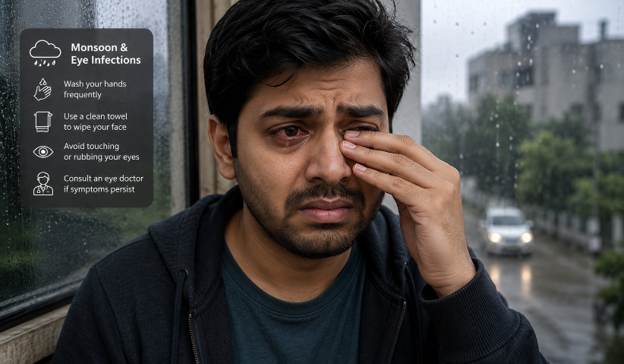

Ask anyone who’s lived through an Indian monsoon, and they’ll tell you two things happen at the exact same time every year. First, that glorious relief when the first rains finally break the summer heat. Second, the sniffles, the coughs, and this one catches people off guard: the sudden wave of red, itchy, watery eyes that seems to hit entire families, offices, and school classrooms all at once.
It’s not a coincidence. And it’s not just “one of those things.” Dr Mahesh Garg, a senior ophthalmologist at Nihar Netralaya in Indore with over three decades of clinical experience, has watched this exact pattern repeat itself year after year, and honestly, once you understand what’s actually happening biologically, it stops feeling random at all.
The Humidity Problem Nobody Talks About
Here’s the thing about monsoon air: it’s basically a greenhouse for bacteria and viruses. High humidity keeps moisture sitting on surfaces, on skin, on hands, everywhere pathogens like to hang around a little longer than they would in dry heat. Add waterlogged streets, overflowing drains, and puddles that splash straight into your eyes on a scooter ride home, and you’ve got a near-perfect storm for what doctors call conjunctivitis, though most of us just call it “eye flu.”
Bacterial and viral conjunctivitis both spike hard during these months. Viral cases, in particular, spread like wildfire: one kid comes back from school with pink, gunky eyes, and within days half the classroom is rubbing theirs too. It’s contagious in a way that surprises people, mostly because eyes touch everything: hands, pillows, towels, phone screens. You don’t even realize you’re passing it along.
Kids Get Hit Hardest, And Here’s Why
If you’ve got children, you already know monsoon means a rotation of runny noses and skipped school days. Eyes are no exception; actually, kids are more vulnerable here than adults, for a pretty simple reason. They rub their eyes constantly, wash their hands less consistently than we’d like, and share everything from crayons to cricket bats without a second thought. That’s a direct transmission line for conjunctivitis.
Parents often assume redness means allergy and try home remedies first, which can delay proper treatment by days. That gap matters. An infection left untreated for a week can turn a mild irritation into something that needs a longer, more aggressive course of antibiotics or, worse, risks corneal involvement if it’s a more stubborn bacterial strain. The rule of thumb doctors tend to repeat: if it hasn’t improved in 48 hours, or if there’s pain, light sensitivity, or blurred vision alongside the redness, it’s time to stop guessing and get it looked at.
Contact Lenses and Monsoon Don’t Mix Well
This one’s for the contact lens wearers out there and there are a lot of you. Monsoon humidity plus lens wear is genuinely one of the riskier combinations in eye care. Moist environments are exactly where fungal organisms thrive, and fungal keratitis, while less common than bacterial conjunctivitis, is far more serious. It can threaten vision if it’s not caught early.
The advice here isn’t complicated, just easy to ignore: don’t sleep in your lenses during monsoon, don’t top off old solution instead of replacing it fully, and if your eyes feel gritty or your vision’s slightly hazy for more than a day, switch to glasses and get it checked rather than pushing through. Contact lens hygiene is one of those things everyone knows in theory and forgets in practice, especially when you’re rushing out the door in the rain.
Simple Habits That Actually Help
None of this means you need to lock yourself indoors until October. A handful of small habits go a long way:
- Wash hands frequently, especially before touching your face or eyes
- Avoid sharing towels, pillowcases, or eye makeup during this season
- Keep a separate handkerchief or tissue for wiping your eyes if they’re watery
- Don’t rub your eyes with unwashed hands, even if they itch like crazy
- If someone at home has conjunctivitis, keep their bedding and towels separate until it clears
None of these is groundbreaking, but that’s kind of the point: the fixes are boring and simple, which is exactly why people skip them. Consistency matters more than intensity here.
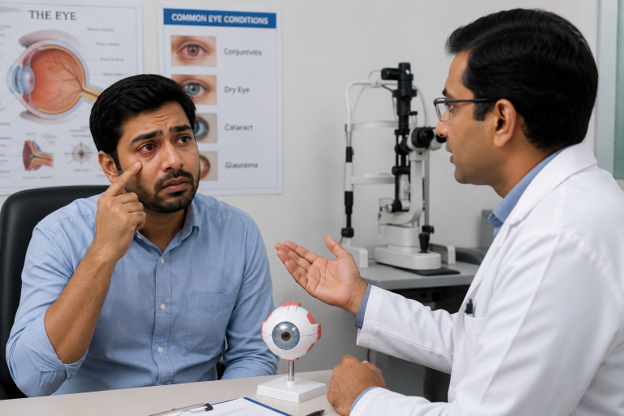
When Home Remedies Stop Being Enough
There’s a strong cultural pull toward waiting things out, especially with something as “minor-seeming” as red eyes. Rosewater, cold compresses, and turmeric water most households have a go-to remedy passed down for generations. Some of these do offer mild comfort. None of them treats an actual bacterial or viral infection at its source.
The honest answer is that most conjunctivitis cases do resolve on their own within a week to ten days, viral ones especially. But “resolves on its own” isn’t the same as “should be ignored,” particularly when it’s this contagious and this easy to pass between people sharing a home, office, or classroom. Getting an early diagnosis often means the difference between antibiotic eye drops clearing it up in three days versus a week of discomfort, missed work, and a household full of people catching it one after another.
The Bottom Line
Monsoon eye infections aren’t some mysterious seasonal curse; they’re a predictable outcome of humidity, standing water, and close contact, and once you know that, protecting yourself gets a lot more straightforward. Wash your hands, don’t share what shouldn’t be shared, and don’t brush off eyes that are staying red, gritty, or watery for more than a couple of days.
If your eyes are already bothering you right now, don’t just wait and hope it passes. This detailed guide on treating an eye infection quickly walks through what actually helps in the first 24 hours, and when it’s time to stop self-treating and see a doctor instead. Monsoon will pass in a couple of months anyway — no reason to spend it squinting through irritated eyes when a little precaution (and the right first-day care) goes such a long way.